


Revision tips, from those across the spectrum!
- May 3, 2018
- 2 min read
So, Exam season is here today, and many worry about how to revise, and the dread of sitting down and focusing for hours on end! But don't worry, as we at Eureka have some tips for you - so here they are;
Ways to revise across the spectrum!
*disclaimer, this is only advice, you know what works best for you!
1. Diagnosis: (Aspergers/HFA)
Revision:
1) Teaching/ explaining it to others
2) Revision cards
3) Practice questions
4) Essay question plans
5) Look-cover-write-say-check
2. Diagnosis: (OCD/Aspergers in-progress)
Revision:
1) Go to office hours (this is more for the weeks before the actual exam, but discussing things with a professor helps a lot)
2) Reviewing practice problems
3) Make sure you understand the theory behind the questions
4) Get some rest and proper food. Try not to burn yourself out
5) Take your time on the morning of the exam and be prepared
3. Diagnosis: (Aspergers, Dyspraxia, Sensory Processing Disorder, Specific Language Impairment)
Revision:
1) Read through your notes, textbooks, listen to lecture recordings if they're available.
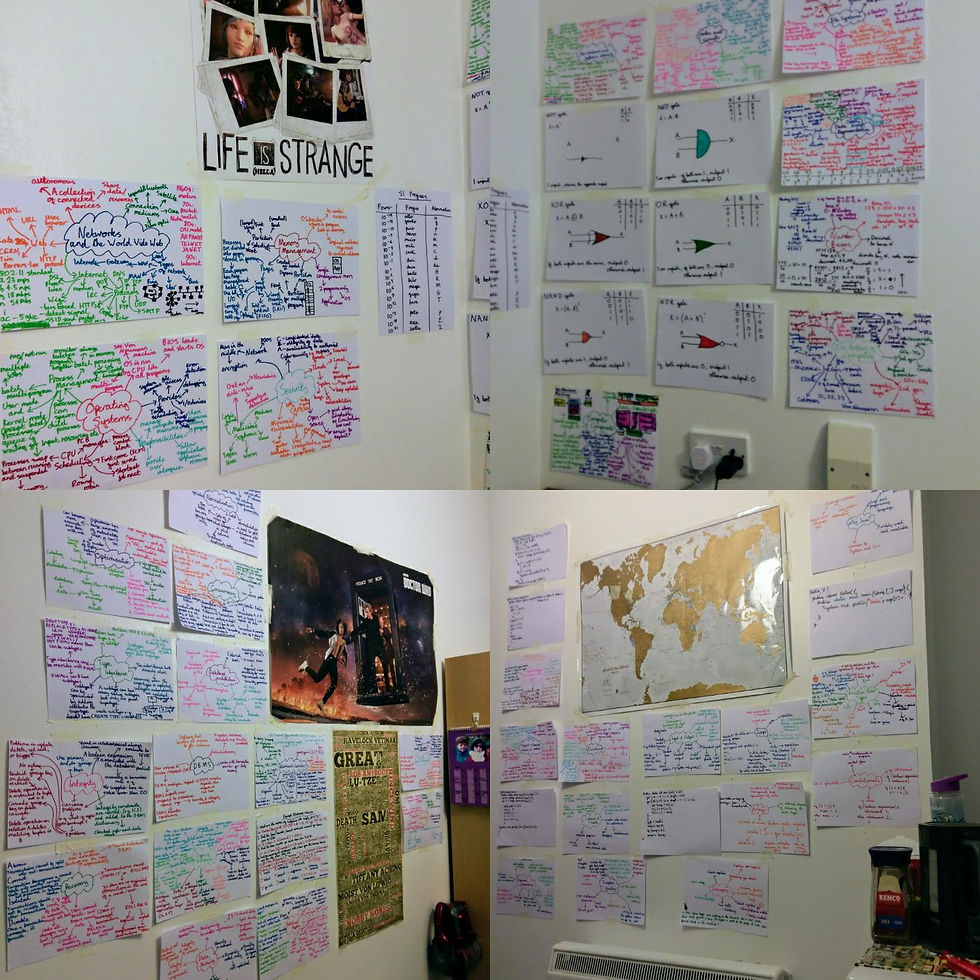
2) Make mind maps and stick them where you'll see them day to day so you can't ignore them!
3) Do past papers and mark them.
4) The night before the exam I tend to go swimming and then watch some TV with a glass of wine, I think it's important to do something to relax and avoid panic!
Here's some examples of their revision technique (They do a Masters in Computer Science)
4. Diagnosis: (Autism, probable ADHD, and anxiety)
Revision:
1) Teaching other people (including pets)
2) Compiling all notes and rewriting them concisely
3) Using colour, highlighting the specifics
4) Flash cards for relevant quotes- writing all over the books
5) Practising writing out individual paragraphs (Disclaimer: I’m a humanities student so a lot of this is redundant for STEM)
5. Diagnosis: (Asperger's, ADHD, Dyslexia)
Revision:
1) When you have the unlikely urge to revise - REVISE, even if it's 2am or when you're eating tea (or dinner as other people know it as!)
2) Don't over-revise - revising is important but only when you can recall it afterwards!
3) Don't overly change your original routine - especially if you have ADHD, if you volunteer, still volunteer, play sport, still play sport- if you shake up your original routine too much it can do more harm than good - Do what you think you can manage, but don't give it all up!
4) Pictures, pictures, diagrams, colours! Make it interesting and engaging - you're more likely to remember stats in a colourful diagram that one sandwiched in a sentence!
5) Wake up an hour or two before the exam, have a cuppa and flick through those beautiful revision notes - take a deep breath, talk if it helps and try to relax, see it as a quiz rather than a test!
Happy revising and good luck from all of us at The Eureka Project!
Comments